My friend tested positive for Tuberculosis. She is young, a vegetarian, and exercises every day. She has good grades and wants to go to medical school. And now she’s going to die.
Actually, probably not, TB is pretty treatable, but it certainly doesn’t look like any fun. But her anxiety over the positive test is natural. I don’t know if probability is good for soothing anxiety, but given her positive test, what is the probability she actually has Tuberculosis? How worried should she be?
Getting tested for Tuberculosis is apparently standard protocol for health care employees, and was a required test for my friend as she was just accepted to a medical internship. Required medical tests are a useful screening process, because obviously you can’t let a sick person work with people who may have compromised immune systems. Apparently Tuberculosis kills lots of people with compromised immune systems and can even live inside the body in a latent form, producing no symptoms until it “activates” and tries to kill you (how many biology classes do you think I’ve had?).
But, sometimes tests fail, and when you apply medical tests to people who are healthy, you occasionally get a false positive. Even low false positive rates can imply that, given a positive test, the probability you actually have the disease can be fairly low. This is a result of Bayes’ Theorem, which has the form 


If we want to apply Bayes’ Theorem to my friend’s situation, Then we need to know what probabilities to enter into the denominator of the above expression. This means we want to know the Probability of a positive test result when someone has TB and when they don’t, which essentially means we need to know the Sensitivity and Specificity of a test.
The test my friend was given here was apparently the QuantiFERON-TB Gold, which is a blood test for Tuberculosis. According to this resource for health professionals, the Specificity of the test is 

I would probably categorize my friend as a “low risk individual”. She’s a white, US-born, middle class female, which is the demographic with the lowest risk for just about anything you can think of except, perhaps, buying Starbucks while wearing Uggs (an affliction she did not escape, sadly.)
All that remains is to know the probability of contracting TB in the US for her demographic. California seems to have a slightly higher rate of TB than the rest of the country, with a reported case rate of nearly 6 per 100,000 people. Case rates aren’t probabilities, and my prior belief is that if there is a flat probability for contracting TB in California, it’s higher than this. Also, apparently TB is complicated, and it can lie dormant inside people for years before activating. But, we aren’t necessarily interested in the probability of active TB, but rather just TB or not TB. Apparently 1% of the world population is infected each year, 
If a probability of 

So now, we can use Baye’s Theorem and calculate the probability my friend has TB. We’ll use a Sensitivity of 92% and a Specificity of 99.5% (as indicated from the statistics on the QuantiFERON test). So we have a True Positive Rate of 92% and a False Positive Rate of 0.5%. By Bayes’ Theorem,

I would probably bet about $50 that she does not have TB, but the above probability is high enough that I would bet $0 that she can get away with not going to a doctor.
Here’s a plot of the probability she has TB, as a function of the probability of TB. Since we are not confident in a particular probability of contracting TB, we might as well look at all of them.
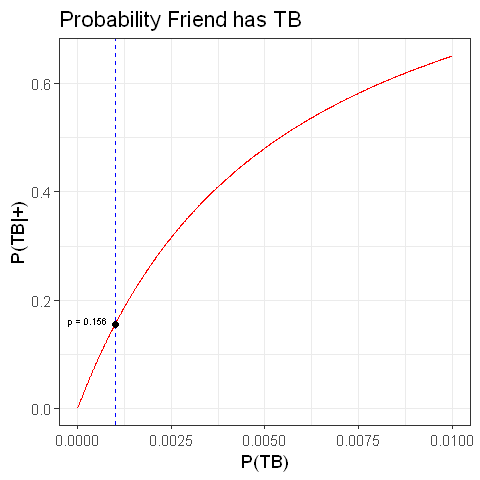
The blue line and point indicates what which value of 
That’s not a bet I would take.
In any case, she’ll probably be fine, but she if she does end up having TB, it does seem like she’s exceedingly unlucky.

 Probability Measure